







A lot of modern devices and appliances offer smart features. These features promise to let you monitor and control your devices remotely or add them to your smart home, at a premium price point.
So what if you could save yourself money by using Home Assistant to reproduce the smart features for you? Good news—you can!
The smart device premium usually buys you a cloud connection
You’re paying to share your data with a third party

When devices advertise smart features, it’s often the case that what this really means is that your device can connect to the cloud. For example, my Samsung washing machine is a smart model, which means I can control it through an app. In order for this to work, the information from my washing machine is sent to the cloud, and the app can control and monitor the washing machine through this cloud service.
The problem is that your device or appliance only stays smart as long as you have an internet connection, and the cloud service is up. If your internet connection goes down or the cloud service fails or is shut down, you can’t use the smart features of your device. I could be standing right next to my washing machine, but tapping a button in the app would have no effect.
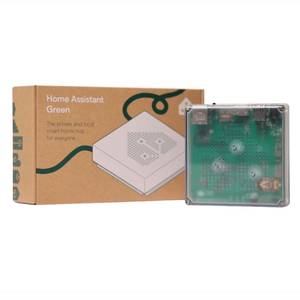
- Dimensions (exterior)
-
4.41″L x 4.41″W x 1.26″H
- Weight
-
12 Ounces
Home Assistant Green is a pre-built hub directly from the Home Assistant team. It’s a plug-and-play solution that comes with everything you need to set up Home Assistant in your home without needing to install the software yourself.
SmartThings proves why this can be bad
Free smart features can end up needing a subscription

The problem goes further than concerns about reliability. When you rely on a cloud service, the features are completely out of your control. If a company decides to put a feature behind a paywall, or remove it completely, there’s not a thing you can do about it.
My smart washing machine is a perfect example. I connected it to Home Assistant using the SmartThings integration which lets me see things such as the current machine state and the power usage. The integration uses the SmartThings API to connect Home Assistant to my washing machine.
Unfortunately, Samsung is removing free access to the SmartThings API, which will require a $4.99-per-month subscription from October 2026. This means I will have to pay to continue to be able to see the state of my washing machine in Home Assistant, even though both my Home Assistant server and my washing machine are in the same house. This is far from the first time that smart features that were once free have been moved behind a paywall.
A lot of smart features can be reproduced
Home Assistant and a little ingenuity have you covered
The good news is that you don’t have to be held to ransom by cloud services. Using Home Assistant, it’s possible to reproduce many of the features of smart appliances and devices without having to purchase the smart models at all.
For example, the only ways I ever used the smart features of my washing machine were to notify me when the washing cycle had finished and to keep track of how much energy it was using. You can do both of these things using a smart plug.
An energy-monitoring smart plug can track how much energy is being used when the washing machine is running. Since the washing machine doesn’t draw as much energy when the wash cycle isn’t running, you can also create an automation that notifies you when the cycle has finished. Since a washing machine has a high power draw, you’ll need to use a smart plug that’s rated for heavy appliances.
You can also tell when a washing machine or dryer has finished using a vibration sensor to determine when it’s stopped vibrating. Contact sensors can tell you when your fridge door is open or you can use sound detection to listen for the beeps that tell you when your dishwasher cycle has finished.
Local control means things keep working for free
No one can paywall your vibration sensor

The benefit of using Home Assistant to reproduce smart features, rather than relying on cloud services, is that you get local control. As long as the smart devices you’re using don’t rely on cloud services themselves, you can keep everything completely local, so that no information needs to leave your home network.
This means that you’re no longer held hostage by a cloud service. You don’t have to worry about features going behind a paywall or being removed completely. Your local solution will keep on working as long as your Home Assistant setup keeps running.
Dumb devices can save you money
For some appliances, opting for a smart model can cost you hundreds of dollars more than an equivalent dumb model. Even if you need to buy additional hardware such as sensors to recreate the smart features, you’re likely to save a considerable amount of money by sticking to the dumb model. It’s yet another way that Home Assistant can save you money.