






Ray tracing has come a long way since Nvidia first made it the headline feature of its RTX 20-series GPUs back in 2018. I don’t know if you remember, but the initial impressions were mixed because you had to drop to 1080p to get better reflections or shadows, even on a flagship GPU like the RTX 2080 Ti. Gamers made it clear that the performance hit was simply not worth it, especially when the visual upgrade didn’t feel dramatic. Then we got DLSS, which helped offset the FPS hit, but its early implementations looked like a blurry mess.
Fast-forward to today, and we have games that support path tracing, which is basically full-on ray tracing rather than selectively applying RT effects. We even have significantly more powerful GPUs like the RTX 4090 and 5090 that can run the latest AAA titles at 4K/60fps natively without RT for the most part. And with DLSS upscaling now looking just as good as native 4K, along with frame generation to boost FPS, ray tracing should be a no-brainer at this point. Yet, I still don’t use it on my RTX 4090 unless the game forces me to.
60fps isn’t my target anymore
I’m aiming closer to 100fps, and I can’t get there even with DLSS

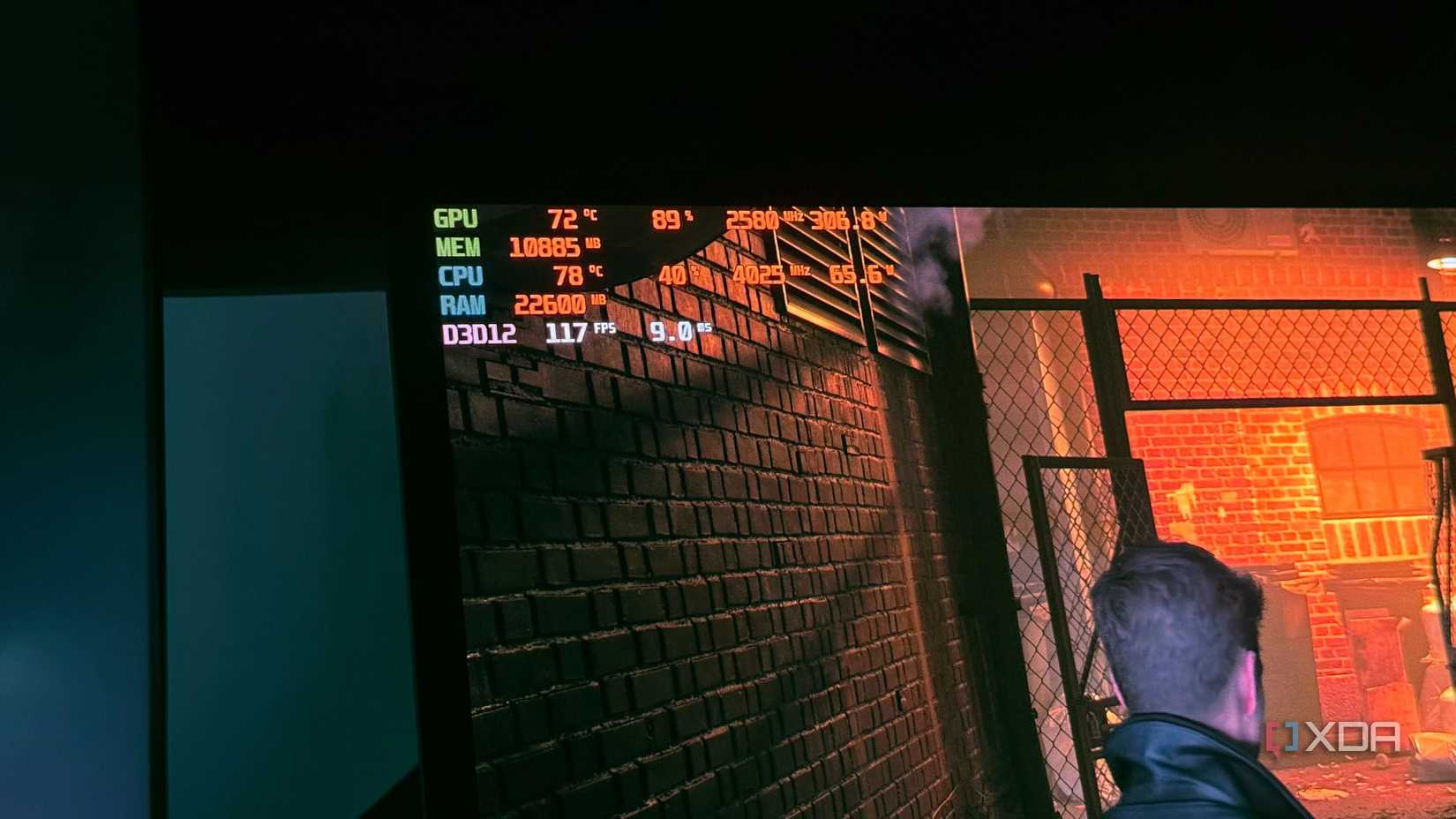
My RTX 4090 can hit 60fps in many AAA titles like Assassin’s Creed: Shadows, Cyberpunk 2077, and Black Myth: Wukong with ray tracing, but I need DLSS to get there. And sometimes, even DLSS Quality isn’t enough to get those numbers. For instance, I need to settle for DLSS Performance in Black Myth: Wukong to get around 60fps. But here’s the thing: I’m not trying to game at 60fps like I used to a decade ago. Now I have a 4K/144Hz monitor, and even though 144fps is overkill for single-player titles, I like aiming closer to 100fps.
At this point, my eyes have adapted to high refresh rate OLED monitors, so 60fps just doesn’t feel smooth enough. I can immediately tell the difference between 60 and 100fps the moment I move the camera around. In fact, I feel more comfortable when frame rates stay above 80, but ray tracing just gets in the way of that. You could argue I need the RTX 5090, but considering it’s only about 27% faster at 4K, even that’s not enough to get me close to 100fps with ray tracing. I’d rather disable ray tracing than spend $4000 on a GPU just to get closer.
It doesn’t look good enough to justify that FPS hit
Better lighting stops mattering once you’re focused on the story anyway
Ray tracing, when implemented properly, as in Cyberpunk 2077, delivers a huge visual uplift. Better reflections are the obvious part, but what stands out more to me is how much more natural lighting can look when shadows, indirect light, and reflections all work together. However, its implementation is hit-or-miss for the most part. Take a look at the comparisons above showcasing path tracing in Doom: The Dark Ages. In some scenes, it does look genuinely better, whereas in others, I need to pause and look closely to notice what changed.
That’s the problem I have with ray tracing, even today. If I need side-by-side comparisons to appreciate the upgrade, is it really worth compromising more than half my frame rate? I’m sure most of you would say no. Mind you, I do love it when a game looks incredible, but once I’m focusing on the story, I barely even notice that extra “realism.” If anything, path tracing feels more like the difference between Medium and Ultra settings. Except in this case, I’m sacrificing way more performance.
Frame generation makes path tracing finally playable
But frame generation doesn’t feel like native performance

Path tracing is extremely demanding, even on flagship GPUs like the RTX 4090 and 5090. For instance, Cyberpunk 2077 runs at around 30fps with path tracing at native 4K. On my RTX 4090, I get around 25fps. You may have seen it in Nvidia’s demos, but the company uses this game to show what frame generation is truly capable of. With DLSS and frame generation enabled, frame rates can jump from around 30fps to well over 200fps. Upscaling alone wouldn’t even get you close to the triple-digits, but frame generation actually makes path-traced AAA titles playable on high-end GPUs.
However, using frame generation isn’t without compromises, or I’d happily use it. My biggest issue with this feature is that the responsiveness is still tied to your base frame rate, so I still feel like I’m playing at a much lower frame rate despite the FPS boost. It improves smoothness, sure, but when your inputs feel slightly off and the camera movement feels less responsive, frame generation loses its appeal. From my experience, it works best when your base performance is already strong. With path tracing enabled, you’re not getting that solid baseline most of the time.
I’ll keep turning it off until GPUs catch up
Path tracing shows what’s actually possible when developers stop faking lighting and instead use hardware to brute-force it. However, we’re still sort of in the early-adopter phase, which is why you clearly need a flagship GPU to get playable frame rates, even with upscaling and frame generation. I’m totally fine with upscaling, but frame generation is rarely worth the trade-offs. So I’d rather wait it out until GPUs get powerful enough to handle path-traced games at 100fps without frame generation. At least for me, visuals only matter once gameplay is smooth enough.

I disabled frame generation in three AAA titles, and it proved some games are better off without it
Turns out, frame generation isn’t the “magic fix” it’s ought to be



.jpg?width=1200&height=630&fit=crop&enable=upscale&auto=webp "Jobs roundup: July 2026 | Robert Henrysson steps down as Supermassive Games CEO")