






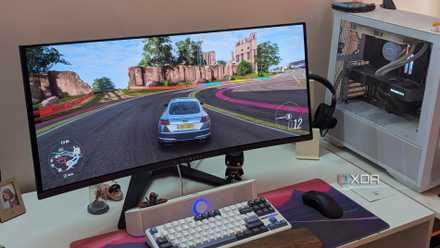
What do all the highly detailed, almost lifelike games like the Forza Horizon series, Black Myth: Wukong, Uncharted, God of War, and Microsoft Flight Simulator have in common? Each game represents one of the most stunning uses of photogrammetry in gaming. It is the only reason why a screenshot from Microsoft Flight Simulator, viewed from a virtual window seat, can look almost indistinguishable from a real photograph taken over the same terrain.
Photogrammetry’s presence in gaming has been expanding over the past decade, and the latest example is Forza Horizon 6, which has taken the racing genre by storm ever since its release. Playground Games sent teams to Japan to capture real skies, road textures, and geology through photogrammetry, which is how players experience Tokyo City, the famed Shibuya Crossing, Mount Fuji, and the flora and fauna of the region in true-to-life detail.
The technique seems to be becoming more commonplace across major titles, and so does gaming’s growing reliance on frame generation.
Photogrammetry is how studios blur the boundaries between games and reality
Thousands of actual photographs modeled into game assets
At its core, photogrammetry is a reconstruction technique. To build a digital model, a team captures an object or a landscape from hundreds (or sometimes thousands) of overlapping angles, feeding the photographs into software that calculates depth, geometry, and texture from the differences between shots, generating assets built from reality itself.
Earlier attempts at photogrammetry often required meticulous alignment of individual images captured; however, modern rendering pipelines make it possible to leverage GPU acceleration to vectorize and stitch thousands of photographs in a fraction of the time it would’ve otherwise taken, all while extracting depth and surface detail with a level of fidelity that was otherwise impossible.
That’s how Asobo Studio mapped the entire globe in Microsoft Flight Simulator 2020 and 2024, and how Playground Games built the landscapes of Japan, Mexico, and Northwest England in Forza Horizon 6, Forza Horizon 5, and Forza Horizon 4, complete with residences, places of interest, and monuments.
Photogrammetry is extremely heavy on most GPUs
It’s more expensive to render, and that changes things

Because photogrammetry creates high-fidelity 3D assets by stitching together thousands of ultra-high-resolution images, it is only natural that processing, loading, and rendering hyperrealistic textures require significant GPU processing power and video memory. Assets that are captured this way can arrive as models with millions of triangles and several large texture maps attached, and if you consider the sheer scale of them, as in Forza Horizon series, having an entire city block scaled up from that baseline becomes an enormous amount of geometric and texture data. It’s not entirely unusual for studios to spend considerable engineering effort just getting these assets down to a size that a game engine can render in real time, sixty times a second, without hiccuping.
Although successful, well-optimized implementations have been seen in the past, photogrammetry almost always comes with a hefty VRAM tax. High-resolution texture data has to sit in the VRAM the entire time, and rendering photorealistic environments natively always drag down frame rates. That’s exactly why developers often rely on frame generation to maintain photogrammetric assets while preserving game fluidity.
Microsoft Flight Simulator 2020 was the first real warning of its demand
No GPU was ready for it on the day of release
Microsoft Flight Simulator 2020 was off to a famously rocky start thanks to the game’s rendering ambitions, which definitely outran the hardware available to consumers. The simulation streamed over two petabytes of satellite and photogrammetry data from Microsoft’s Azure cloud, rendering cityscapes and skylines of the dense landscape of New York, London and Tokyo in 3D rather than the flat terrain older simulators relied on. Loading all of that into a scene demanded VRAM and memory bandwidth far beyond what was typical at that time.
To make matters slightly worse, the CPU also came into play. MSFS 2020 launched on DirectX 11, an API that’s notoriously weak for multithreading. Even owners of 8 or 12-core CPUs saw the game hammer one and two cores while the rest sat idle. Naturally, the CPU couldn’t feed geometry to the GPU fast enough, resulting in stutters that worsened the lower and slower you flew over a photogrammetry-dense city.
The RTX 2080 Ti, the Turing flagship, was the absolute best GPU money could buy at the time, and yet it could only average 30–40 FPS at 4K resolutions. Furthermore, DLSS 2.0 had arrived, but the simulator didn’t quite support it at launch, while frame generation was nonexistent. Only after years of patching, a shift to DirectX 12, and the arrival of the Ada Lovelace GPUs did photogrammetry finally become viable. Even today, midrange Blackwell and Ada Lovelace GPUs such as the 4070 Ti and 5070 Ti can only offer a fluidic graphical experience with frame generation on, since raw rasterization still doesn’t seem to cut it.
Frame generation seems to be the new foundation
While most gamers hate to confront this, all signs point to frame generation as the new foundation on which all improvements in graphical fidelity and fluidity are built. The evidence is all over the place, and silicon giants like Nvidia seem to be pushing for this with features like 6X Multi Frame Generation and Dynamic Multi Frame Generation. Features like ray-tracing, path tracing coupled with photorealistic visuals seem to demand more than just rasterization, and the list just keeps getting longer.