





Google has built some of the most consequential consumer AI tools in the past two years. NotebookLM, Gemini, Google Opal, and a handful of others sit on a list of products that have advanced what consumer-facing AI can do for research, learning, and creative work. Each one solves a key problem that competing tools haven’t addressed, or rather, addressed less elegantly.


The problem is that Google appears to have no clear vision or direction for these very useful tools. NotebookLM now has millions of users globally, but it spent years in obscurity before it became mainstream. Gemini Omni, the latest and perhaps the most powerful consumer video generation model, on the other hand, is being marketed to make TikTokers look like Disney characters on social media. Google Opal launched with a positioning so vague that a sizable portion of its addressable market has no idea it exists. It is unfortunate, especially given the transformative potential these tools have in the right workflow, and I had a chance to experience it firsthand in my experiments.
I tried Gemini Omni, and it’s so good it feels straight out of science fiction
There’s a new king of video generation in town, and it’s no joke
But Google thinks it’s better suited to making TikToks and reels
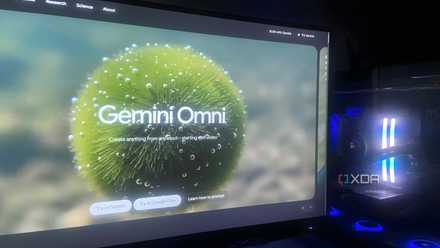
Gemini Omni is, by a long shot, the most capable free video generation platform that consumers have ever had access to. Before its arrival, AI-generated video was anything but mainstream and limited to a set of YouTubers with an appetite for niche video generation. OpenAI’s now sunsetted Sora attempted something similar, but its access was locked behind a paywall that priced out casual users, and the quality ceiling never really warranted paying a premium in the first place. Gemini Omni achieved two major milestones, first by making the entire category free, and second by making it immediately accessible to anyone with a Google account.
The mere fact that Omni inherits Gemini’s working understanding of “world history, science, and mathematics” and draws upon that breadth during the generation process itself makes it unlike any consumer-facing video-generation platform on the market. Over the past few weeks, I have used it to create cinematic product visualizations, claymation-style explainers of complex concepts such as Einstein’s theory of general relativity, and even bring static sketches I’ve doodled into fully animated clips that resembled the work of a small production studio. It is evident that the use-cases practically write themselves.
For marketers in generating ideas surrounding a commercial, educators attempting to make learning more visually interactive, researchers communicating findings to non-specialist audiences or learning and development professionals building training materials that don’t put a room to sleep within the first ten minutes, Omni offers a starting point that simply did not exist a few months ago. And yet, none of these use cases are visible anywhere in Google’s marketing materials. As a matter of fact, the closest thing Omni’s landing page comes to acknowledging them is a passing reference to “creators”, which more than likely seems to be shorthand for the social media variety.
Google Opal brings intelligent automation for non-coders
And asks for nothing in return
Google Opal came out of Google Labs, the same group responsible for NotebookLM. That should tell you something about the design philosophy from the very outset. Where Opal most clearly succeeds is its capability to visualize workflows, specifically the kind that lets users “describe” what they want a process to do in plain, natural language and watch it assemble into a coherent, editable workflow on the screen. The interface then translates instructions into a visual graph, providing the user with an automated workflow that, in comparison, makes every other automation tool feel antiquated by design.
The moment I used it, I immediately realized who it was designed for. Opal is built for people who want to leverage automation without ever needing to write a PowerShell script, host a local agent, or use Claude to spawn agents and sub-agents. When I use Opal, I think of university professors looking to organize their course material and evaluation criteria, accounting professionals who want to streamline their reporting, data analysts who wish to bring more structure to their analytics pipeline, and just students working through literature reviews and dissertations with vast amounts of data that can’t be made sense of all at once.
The value proposition it offers to non-coders is unfathomable, and the fact that it’s simple and free to use raises that utility tenfold. Yet, every single time a coverage of Opal comes up, the overwhelming response from users signals discovery rather than recognition. It is truly a product that has been let down by its marketing, which is, in essence, also happens to be similarly nonexistent.
Google Opal does what Cursor and Claude Code can’t by letting me build apps without touching code
Google continues to democratize app development, and it has me excited
Google continues to not understand its own products
Brilliant engineering, baffling positioning, every single time

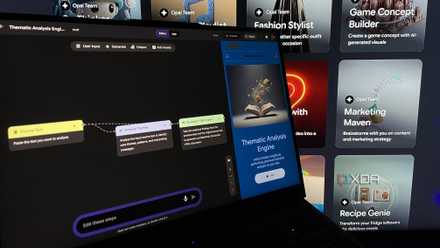
Google Opal is designed to be kind to those who can’t code and, in the process, it solves a very pressing problem, which is alienation. I say “alienation” because existing tools have done precisely that by demanding a pre-requisite skill that the user neither has nor has the time or resources to acquire. The barrier to entry also seems to be non-existent. With just five minutes of my time and a few natural language prompts, I was able to create a narrative analysis tool, a thematic analysis engine, make the two “communicate” and generate reports that would have otherwise taken hours of my time.
Similarly, Gemini Omni has also played an important role in democratizing video generation in a market where no other user-friendly (and dare I say, usable) alternatives exist for those without specialized knowledge of local AI inference or those without the dedicated hardware for it. Having experienced Omni’s capabilities to rapidly generate output from text, audio or images from a subject-matter expert’s perspective, the colossal gap between what the model can do in the right hands versus what Google is showing the world big enough to class it as a strategic failure.
Despite having the solutions, Google does not know who needs them the most
There is, of course, an undeniable economic and accessibility incentive for the non-specialist communities through the use of these tools. In institutions such as universities and schools, as well as public healthcare, access to automation has always arrived with a huge bill and a large lead time, mostly because it requires capital expenditure on contracts (provided such contracts go through negotiation in the first place) and thereafter, their integration and delivery. Because such an extent of automation requires specialist teams to build and deliver, most institutions tend to benefit from the tools long after the paradigm has moved on, and sometimes, not at all. Despite having the tools to shift the paradigm and make progress in those communities, Google seems to have a rather narrow view of what its tools can deliver.


